‘The Dig’review-Picturesque but empty period drama
allocine.fr
Recently, film commentators have come to define the term “Dad Film”. Tropes include being “based on a true story”, a male protagonist in a masculine role/ environment (e.g., military, engineer etc.) and most importantly, one that dads across the world will marvel at. They will talk about how Russell Crowe or Christian Bale has become their new favorite actor, as they revel in their own fantasies about commanding a ship of the high sea or winning Le Mans. Think ‘Le Mans 66’, ‘Master and Commander’, Ron Howard’s ‘Rush’ etc.
However, perhaps we should also come to recognize the “Mum Film”. Staples of the “Mum Film” include a period drama setting, usually taking place between 1815 and 1960. Like “Dad Films”, they are often based off a true story or a famous historical novel. Some “comedy of manners” type tropes are usually at play. Equally, tragedy also comes in so all mums can have a good weep. These are films like ‘The Piano’, ‘Atonement’ or the numerous Jane Austen and ‘Little Women’ adaptations’.
This is often what one was thinking about during this lightweight “mum film” ‘The Dig. ‘The Dig’ is nicely shot and features some fine performances, but these never exceed the material. It offers a nice, coziness that will feature mums basking in the glory of the English countryside, whilst giving post-film praise to the “wonderful” performances of Carey Mulligan and Ralph Fiennes. But those looking for something deeper and more meaningful will find little here.
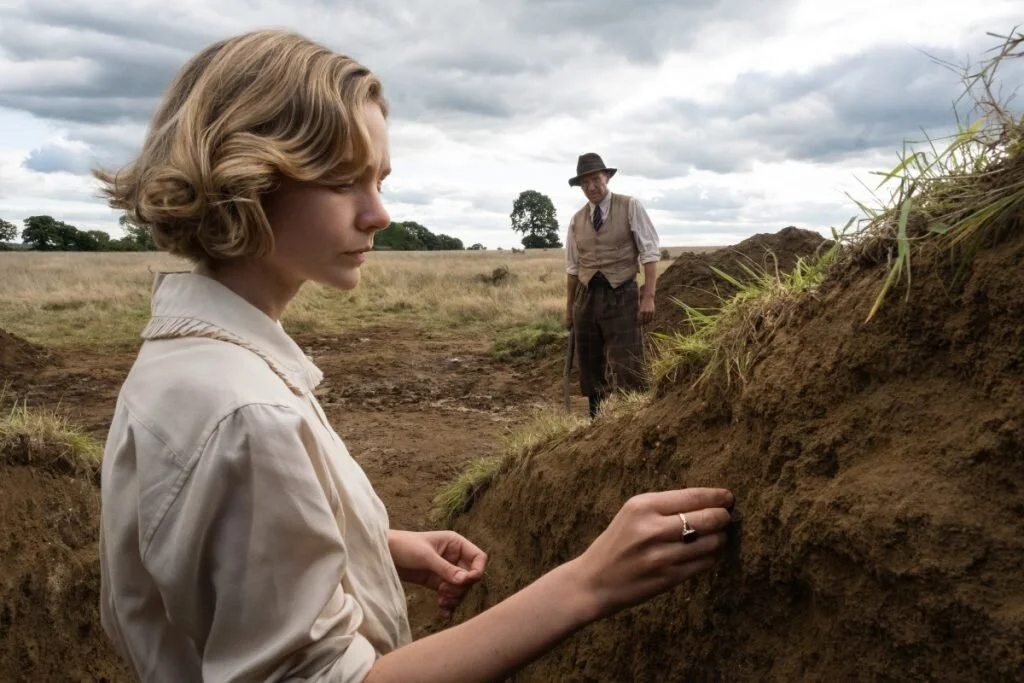
Set during the outbreak of World War II, the narrative focuses on Suffolk landowner Edith Pretty (Mulligan) calling upon excavator Basil Brown (Fiennes) to deal with burial mounds on her land in Sutton Hoo. What Brown and Pretty discover underneath these burial mounds is a large naval ship, from the Viking age. As they bring a team of archaeologists in, both the characters discover more about themselves as they uncover the ship.
Perhaps it is a matter of taste, but the narrative never seemed to offer much cinematic purpose, even with some of the nice scenery and camerawork at place. Director Simon Stone and cinematographer Mike Ely are clearly influenced by the work of Terrence Malick, with many handheld shots of the lustrous countryside Unlike Malick, the narrative is fairly conventional, with a far more structured storyline. Conventionality is certainly not a criticism, as genre conventions can lead to great cinema. But when all one thinks about is how conventional the film is, then there is a problem.

allocine.fr
The performances are good all around, especially Mulligan who continues her place as one of the best actresses working today. Fiennes is also good, delivering potentially laughable lines about his ability to distinguish “Suffolk soil” with conviction and heart. Plus, he has a good ol’ West Country that really gives flavor to the beautiful scenery. And the heart of the film is certainly their friendship, along with their relationship with Mulligan’s son, who dreams of being an astronaut. Stone and his screenwriter are obviously trying to get across that Mulligan’s son looks to the future up in the sky, whilst the archaeological team are digging up the past.
However, the second half begins to drag. There is a rather forced love story between Lily James and Johnny Flynn’s characters (made up for the film) that adds nothing to the narrative. It is as if screenwriter Moira Buffini feels love stories are all period countryside pieces are good for. This is by no means the actor’s fault, but it gives a flatness to their often-good work. It begs the question, why does every film have to feature a love story? Why couldn’t it have been about the friendship between Carey Mulligan and Ralph Fiennes? Or Mulligan and her son? Why is there a subplot about James’s closeted husband? What does this have to do with digging up a ship? It dips into Hollywood melodrama rather than providing the emotional nuance that would have made this more effective.
“The Dig” is a good Sunday watch for mothers and grandmothers alike, that will go perfectly with a cup of tea and slice of lemon tart. Completely inoffensive and well-performed, but we know that “mum films” can be better than this. Just ask ‘Pride and Prejudice’.